
Throughout my life, I’ve been a seeker, driven by an insatiable curiosity to understand the deeper truths of existence. This journey has brought me face-to-face with what is “spiritual combat”—a battle against dark forces that seek to hinder our progress towards enlightenment and closeness to God. Spiritual combat involves encountering mystical experiences, recognizing the reality of magic and witchcraft, and facing attacks from malevolent entities, including the spirit of demons and the antichrist. Those who strive to deepen their spiritual connection are often under heavy assault from these forces. My own battles in this realm have provided me with profound insights and wisdom, compelling me to share what I know despite the opposition from those dark forces that seek to hinder my progress and isolate my teachings. My latest battle in the jungle against the occult, where I declared Lord Jesus Christ as my Savior, has further strengthened my resolve.
According to numerology, I am a #7, The Seeker, a designation that perfectly encapsulates my journey. Born into a Catholic family, my quest for answers has taken me around the globe, exploring various spiritual traditions and teachings. My path has led me to the profound wisdom of the Buddha, whose original teachings in The Pāli Canon I have studied extensively. My pursuit of awareness and enlightenment has also been deeply intertwined with my practice of martial arts, a discipline that has not only honed my physical abilities but also elevated my spiritual consciousness through body awareness.
I have endured much suffering and exploitation, often because of my empathetic nature and the tendency to please others—a trait ingrained in me since childhood. Narcissists and manipulators have targeted me, sensing my vulnerability. However, through martial arts training, I have developed a heightened sense of awareness, enabling me to recognize and navigate the energies around me. Martial arts, for me, is more than a physical practice; it is a spiritual journey that aligns with my quest for enlightenment. I have come to understand the pervasive suffering in the world, echoing the words of Jesus: “Forgive them, Father, for they know not what they do.” My journey has provided me with the word and wisdom of knowledge, which I now feel compelled to share.

Why Are We Here and Why Is There Suffering in the World?
Suffering, discontent, and displeasure exist because of the fundamental nature of human desire and attachment through ignorance, as explained by both Christian and Buddhist teachings. The Bible teaches suffering began when Adam and Eve ate the apple, introducing sin into the world. The Buddha’s Four Noble Truths also address this, identifying the problem as Dukkha, which is an inherent part of human existence caused by greed—craving, desire, attachment, wants, and expectations.
Greed originates from the demonic spirit, a force inherent in human nature stemming from the original sin of disobedience—rebelling against God. The devil, who is prince of the air and earth, holds temporary dominion over this world, leading to the pervasive suffering and pain we witness. This dominion continues only as long as God permits it. While we are here, it is up to each individual to make their own choices through the gift of free will. Will our choices lead to purification and allow the Holy Spirit to enter?
Ignorance is the key factor in our suffering, as echoed in the Buddha’s teaching of Dependent Origination. This teaching, also known as the Chain of Interconnectedness, explains how ignorance perpetuates a cycle of birth, aging, and death:
- Birth conditions aging-and-death: The very act of birth sets in motion a cycle that inevitably leads to aging and death, regardless of external circumstances.
- Existence conditions birth: The yearning for existence, the deep-rooted desire to be, fuels the continuation of this cycle.
- Clinging conditions existence: Attachment and clinging to transient phenomena perpetuate the cycle of existence, leading to further suffering.
- Craving conditions clinging: Craving, born out of a fundamental misunderstanding of true reality, binds us to the illusions of worldly pursuits and perpetuates our discontent.
- Feeling conditions craving: Our sensations and experiences, both pleasant and unpleasant, give rise to cravings, shaping our desires and aversions.
- Contact conditions feeling: Through the interplay of our senses and the world, contact occurs, generating feelings that further influence our desires and experiences.
- Six sense bases condition contact: Our six senses—the gateways through which we perceive the world—play a crucial role in shaping our experiences.
- Name-and-form conditions the six sense bases: The interplay between our mental and physical aspects influences the functioning of our senses, shaping our perceptions.
- Consciousness conditions name-and-form: Consciousness arises in conjunction with our mental and physical aspects, giving rise to the diverse experiences that shape our reality.
- Volitional formations condition consciousness: Rooted in ignorance, our volitional choices and actions generate the karmic seeds that shape our consciousness and experiences.
- Ignorance conditions volitional formations: At the root of this cycle lies ignorance—the lack of understanding of the true nature of reality—that perpetuates the cycle of suffering and discontent. “Forgive them Father, for they know not what they do.” – Lord Jesus Christ

What Is Our Mission on Earth?
Our mission is to cleanse ourselves of the demonic spirit and fill ourselves with the Holy Spirit. This purification process is essential for attaining true spiritual enlightenment, the only permanent reality. This is the ultimate purpose—not your job, career, or money. These are mere distractions from the true mission of your soul.
What Did the Buddha Teach?
The Buddha illuminated the natural laws of existence, karma, and universal truths, offering practices to calm the mind. His teachings provide a roadmap for leading a wholesome life and expanding one’s consciousness, regardless of religious background. The Buddha, the Blessed and Awakened One, guided followers on the path to Enlightenment—a state of being filled with the Holy Spirit, which I express as Christ Consciousness. Enlightenment (English), also known as Nibbana (Pāli) or Nirvana (Sanskrit), represents a state of Christ Consciousness that leads to everlasting life with God. This state of Enlightenment is the only permanent reality. While the terminology differs because Christ was born 500 years after the Buddha, the essence of the teaching remains the same.
What Did Jesus Teach?
Jesus taught faith in one God, emphasizing that He is the way to salvation and eternal life. He provided a path for forgiveness of sins and reconciliation with God, offering guidance on how to live a life of love, compassion, and righteousness. Jesus, the Son of God, is our Savior, the ultimate judge of righteousness and wickedness, and the mediator who connects humanity to the divine. His teachings and sacrifice offer a pathway to the Kingdom of Heaven and the promise of eternal life with God. Jesus taught the path to spiritual fulfillment through love, forgiveness, and repentance. Central to His teachings are the principles of loving God and loving others as oneself. Jesus emphasized the importance of faith, compassion, and humility in obeying, not rebelling. His teachings include:
- The Great Commandment: “Love the Lord your God with all your heart, with all your soul, and with all your mind. This is the first and greatest commandment. And the second is like it: Love your neighbor as yourself.” (Matthew 22:37-39)
- Forgiveness: “Forgive us our debts, as we also have forgiven our debtors.” (Matthew 6:12) Jesus taught that forgiveness is essential to spiritual health and growth.
- Repentance: Jesus called for repentance and turning away from sin. “Repent, for the kingdom of heaven is at hand.” (Matthew 4:17)
- The Beatitudes: In the Sermon on the Mount, Jesus outlined the attitudes and behaviors that lead to blessedness, such as recognizing one’s spiritual neediness (poor in spirit), being gentle and humble (meek), showing mercy, and being pure in heart. (Matthew 5:3-12)
- The Lord’s Prayer: Jesus provided a model for prayer that emphasizes reverence for God, seeking His will, and asking for daily provision, forgiveness, and guidance. (Matthew 6:9-13)
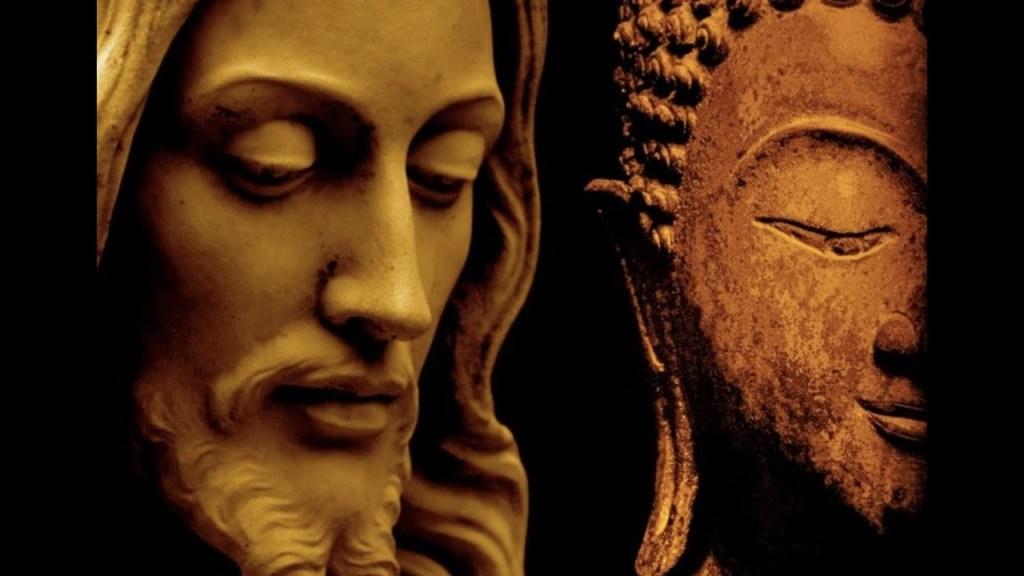
The Path to Enlightenment
The path to Enlightenment, as taught by the Buddha, is the Noble Eightfold Path. I’m expressing this path leads to Christ Consciousness, characterized by the attainment of the nine gifts of the Holy Spirit. By following the Eightfold Path and adhering to the Five Precepts as the Buddha taught, one eliminates The Ten Fetters and aligns with the teachings of the Ten Commandments, paving the way to spiritual purification and ultimate union with God. The Buddha’s original teachings, preserved in the Theravada tradition with The Pāli Canon, offer a comprehensive and accessible roadmap to this divine state.
In essence, the journey to Enlightenment and Christ Consciousness is one and the same. By embracing the wisdom of both the Buddha and Christ, we can navigate the path to spiritual fulfillment and eternal life.

Understanding Narcissism and Demonic Spirits
Narcissists often manipulate others for their own gain. One way to discern if someone is influenced by demonic spirits is to tell them “no.” Their reaction will reveal their true nature: will they obey, showing alignment with God’s will, or will they rebel, akin to Satan’s pride and rebellion? This rebellion manifests the suffering that stems from birth, aging, and death under the dominion of the prince of darkness. The root cause of this suffering, driven by the craving for control typical of narcissists and demons, stems from ignorance. As Lord Jesus Christ said, “Forgive them, Father, for they know not what they do.”
In Summation
Ignorance perpetuates suffering, as illustrated by the Buddha’s teaching of Dependent Origination. Jesus’s plea, “Forgive them, Father, for they know not what they do,” highlights this ignorance. Our goal on earth is to shed the demonic spirit and embrace the Holy Spirit. By doing so, we align ourselves with the divine and attain the true purpose of our existence. This is spiritual combat. The key to success in this battle is awareness.

References:
The Four Noble Truths
Reference: Samyutta Nikaya (SN) 56.11 (Dhammacakkappavattana Sutta)
- The Truth of Suffering (Dukkha)
- is that it Exists.
- Pāli: Dukkha Ariya Sacca
- The Truth of the Origin of Suffering (Samudaya)
- the cause of it is, craving.
- Pāli: Dukkha Samudaya Ariya Sacca
- The Truth of the Cessation of Suffering (Nirodha)
- it can be eliminated.
- Pāli: Dukkha Nirodha Ariya Sacca
- The Truth of the Path Leading to the Cessation of Suffering (Magga)
- the way leading to its elimination is the (humbling and purifying) noble eightfold path.
- Pāli: Dukkha Nirodha Gamini Patipada Ariya Sacca
The Eightfold Path (SN 45.8): This path alleviates Dukkha (suffering, discontentment, and displeasure) by guiding individuals to cultivate wholesome karma through righteous view, intention, speech, action, livelihood, effort, mindfulness, and concentration.
- Right View presented well in a blog series here https://nicholasgerace.blog/blog-2/
- Right Intention
- Right Speech
- Right Action
- Right Livelihood
- Right Effort
- Right Mindfulness
- Right Concentration
The Five Precepts (AN 8.39): Focused on personal ethical conduct and spiritual development, following these will significantly reduce the amount of unwholesome karma returning your way.
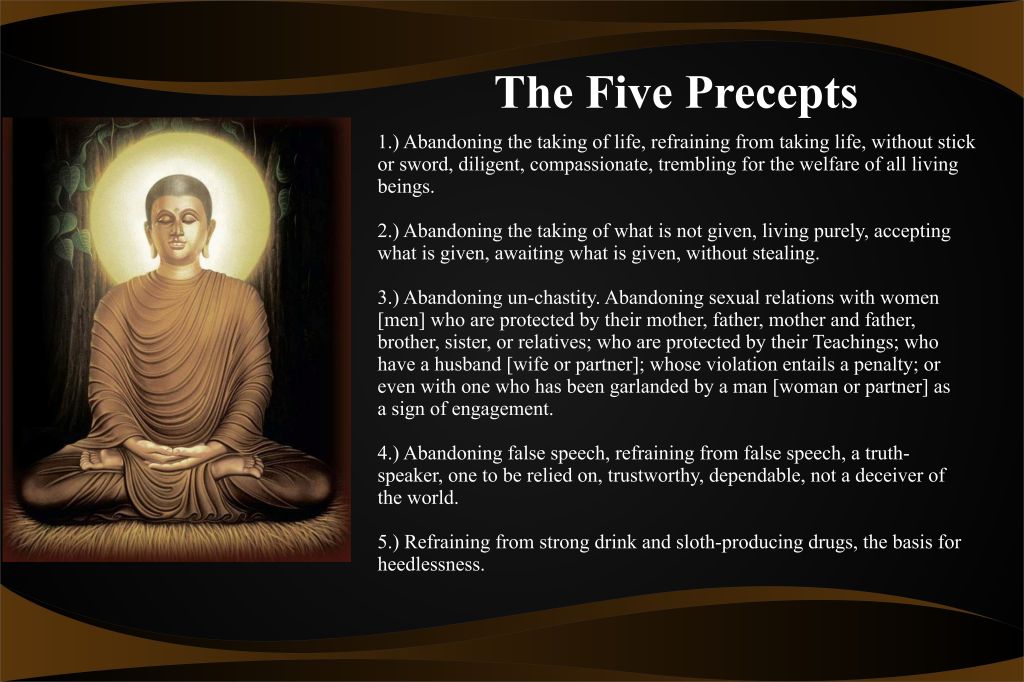
Support: https://thenoblepractitioner.org/collections/framed-poster/products/the-five-precepts-framed-poster
The Ten Commandments, (Deuteronomy 5:7-21): given to Moses, were intended to be a comprehensive set of moral laws for a community.
- You shall have no other gods before me.
- You shall not make for yourself a carved image, or any likeness of anything that is in heaven above, or on the earth beneath, or in the waters below. You shall not bow down to them or worship them.
- You shall not misuse the name of the Lord your God, for the Lord will not hold anyone guiltless who misuses His name.
- Observe the Sabbath day by keeping it holy, as the Lord your God has commanded you. Six days you shall labor and do all your work, but the seventh day is a Sabbath to the Lord your God. On it you shall not do any work, neither you, nor your son or daughter, nor your male or female servant, nor your ox, your donkey, or any of your animals, nor any foreigner residing in your towns, so that your male and female servants may rest, as you do. Remember that you were slaves in Egypt and that the Lord your God brought you out of there with a mighty hand and an outstretched arm. Therefore the Lord your God has commanded you to observe the Sabbath day.
- Honor your father and your mother, as the Lord your God has commanded you, so that you may live long and that it may go well with you in the land the Lord your God is giving you.
- You shall not murder.
- You shall not commit adultery.
- You shall not steal.
- You shall not give false testimony against your neighbor.
- You shall not covet your neighbor’s wife. You shall not set your desire on your neighbor’s house or land, his male or female servant, his ox or donkey, or anything that belongs to your neighbor.
The Nine Gifts of the Holy Spirit (1 Corinthians 12:8-10):
- Word of Wisdom
- Word of Knowledge
- Faith
- Gifts of Healing
- Working of Miracles
- Prophecy
- Discerning of Spirits
- Different Kinds of Tongues
- Interpretation of Tongues
The Ten Fetters
Reference: Anguttara Nikaya (AN) 10.13
- Personal Existence View (Sakkāya-diṭṭhi) – The opposite of selflessness.
- Doubt or uncertainty (Vicikicchā)
- Attachment to rites and rituals (Sīlabbata-parāmāsa)
- Sensual desire (Kāmacchanda)
- Ill will (Vyāpāda)
- Desire for material existence – desire for rebirth in luminous form (Rūparāga)
- Desire for immaterial existence – desire for rebirth in the formless realm (Arūparāga)
- Conceit (Māna)
- Restlessness (Uddhacca)
- Ignorance (Avijjā) – This ignorance is why you exist and are here in this realm.
 Nicholas Gerace